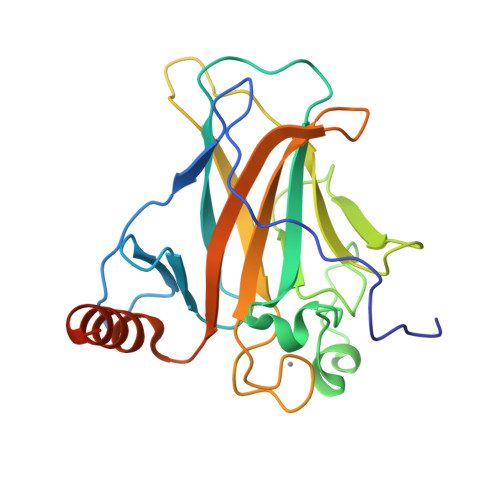
In addition to eliminating a salt bridge, the R282Q mutation has a significant impact on the properties of two DNA-binding loops (L1 and L3).
Isolated TP53 DNA-binding domain crystal structure and molecular dynamics
Case opening · current question
How can functional evidence point in different directions without resolving a clinical classification?
Conflicting submissions are inputs to examine, not a new classification produced by GeneCourt.
Current exhibit updated: Case called to order. A TP53 missense variant with a deposited mutant structure, mixed functional observations, and current ClinVar disagreement.
Case 01 · Conflicting submissions
How can functional evidence point in different directions without resolving a clinical classification?
Exhibit A · deposited structure
Author chain A, residue 282 · label chain A, seq 195
Now hearing
A TP53 missense variant with a deposited mutant structure, mixed functional observations, and current ClinVar disagreement.
Same evidence. Same order. Every time.
The evidentiary record
Claims are extractive, source-linked, and scoped to their model. Queued cards remain readable before their scheduled entrance.
Mechanistic or functional observations that support disruption.
The exact R282Q structure and biophysical work support a plausible structural-disruption mechanism.
In addition to eliminating a salt bridge, the R282Q mutation has a significant impact on the properties of two DNA-binding loops (L1 and L3).
Isolated TP53 DNA-binding domain crystal structure and molecular dynamics
We characterize the stability and conformational state of the tumorigenic DBD mutants R248Q, R249S, and R282Q using equilibrium denaturation and functional assays. Destabilizing mutations cause DBD to misfold when it is part of the p53 tetramer, but not when it is monomeric.
Purified TP53 DNA-binding-domain plus tetramerization-domain construct (residues 94-360)
Observations that resist a simple loss-of-function account.
Other curated functional results report partial transactivation and retained growth-suppression behavior.
Published functional studies demonstrate partially functional transactivation and retained growth suppression activity (PMID: 11429705, 12826609, 12909720, 21343334, 30224644, 29979965).
ClinVar submitter synthesis of yeast and mammalian-cell assays
Functional studies have shown no or partially disruptive effect of this variant on transactivation activity in yeast-based assays (PMID: 11429705, 11896595, 11920959, 12826609, 12909720, 12917626, 21343334) and no effect on the anti-proliferative function of TP53 protein in mammalian cell-based assays (PMID: 29979965, 30224644).
ClinVar submitter synthesis of yeast and mammalian-cell assays
Assay design, model limits, and comparability checks.
The studies use different constructs, cell systems, promoters, and outcomes, so their results are not interchangeable.
We characterize the stability and conformational state of the tumorigenic DBD mutants R248Q, R249S, and R282Q using equilibrium denaturation and functional assays. Destabilizing mutations cause DBD to misfold when it is part of the p53 tetramer, but not when it is monomeric.
Purified TP53 DNA-binding-domain plus tetramerization-domain construct (residues 94-360)
Functional studies have shown no or partially disruptive effect of this variant on transactivation activity in yeast-based assays (PMID: 11429705, 11896595, 11920959, 12826609, 12909720, 12917626, 21343334) and no effect on the anti-proliferative function of TP53 protein in mammalian cell-based assays (PMID: 29979965, 30224644).
ClinVar submitter synthesis of yeast and mammalian-cell assays
Frequency context that informs but does not decide the record.
The variant is rare in the linked population snapshot, but rarity cannot select between the submitted classifications.
Trans-Omics for Precision Medicine (TOPMed) 0.00002.
Population allele-frequency database
Conflicting classifications of pathogenicity.
Cross-examination
The variant-level aggregate spans condition labels; only the RCV record is an exact Li-Fraumeni syndrome 1 comparison.
2 cited exhibitsA purified DBD–tetramerization-domain construct, yeast assays, and mammalian-cell assays test different biological questions.
2 cited exhibitsThe supplied records support structural disruption and also preserve evidence of partial function.
2 cited exhibitsFinal case file
Complete the replay or unseal the structured summary now.
Evidence admission lab
Admission expands the record; it does not rewrite the clinical status. The before/after diff is deterministic and fully inspectable.
Prepared candidate · pubmed
Importantly, expression of the H179Y and R282Q p53 mutants in primary KCs is sufficient to activate endogenous KLF4.